
Places
Acquarica Castle and Reed Museum
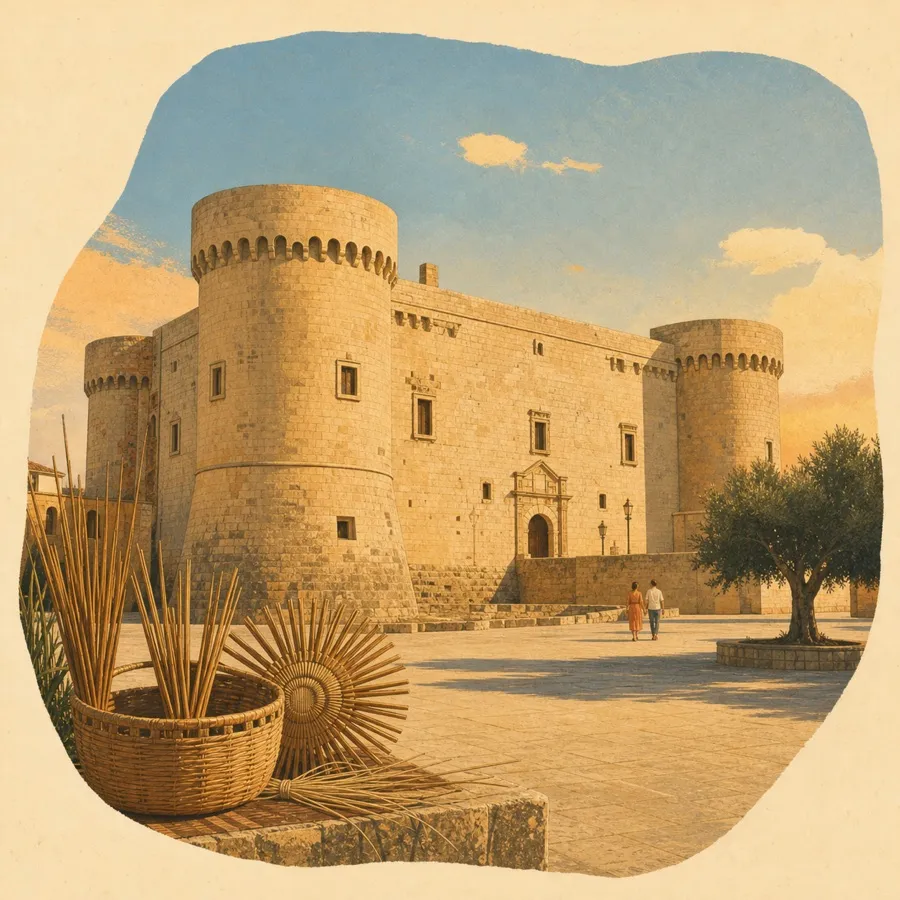
Acquarica's castle is the anchor of the old village, but its familiar description as ‘medieval’ hides a more complicated story. A quadrangular fortified enclosure, traditionally dated to the twelfth century, once measured about forty metres on each side and had four towers. Much of what survives reflects rebuilding from the fifteenth and sixteenth centuries. Only one cylindrical tower remains; its irregular stonework, horizontal mouldings and crown of small hanging arches belong to a later strengthening of the defences.
The building also preserves evidence of life beyond defence. Ground-floor rooms were used for storage and upper rooms for noble residence; in the courtyard, the former Palatine Chapel of Saint Francis contains fragments of wall painting and traces of burials found during restoration. Heraldic signs recall the feudal families who controlled Acquarica, while the monumental stone basin known as the Pila di Pompignano was brought here from an abandoned rural settlement and now stands in the courtyard.
On the ground floor, the Reed Museum explains the craft that made Acquarica known far beyond Salento. Marsh rush—locally called paleddhu—was gathered by hand, sorted, boiled, dried and treated with sulphur until it became pale and flexible enough for weaving. Women artisans produced baskets, carriers and filters for olive presses; the craft reached an international audience in the nineteenth century and received recognition at the Vienna World's Fair of 1873. The museum connects those finished objects to the wetland plants, seasonal labour and skilled hands behind them.
Location