
Places
Ducal Palace and Hanging Garden
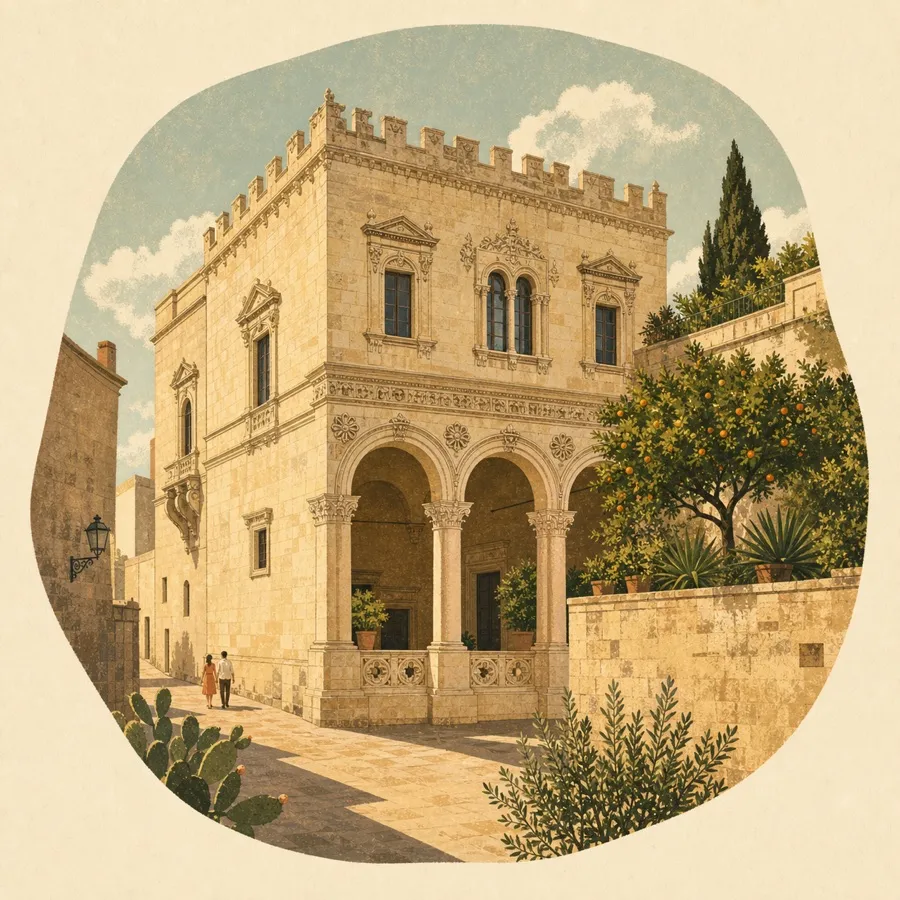
The Ducal Palace is best understood as an architectural palimpsest rather than a building from one precise period. A fortified nucleus protected the early settlement, but successive lords repeatedly enlarged and softened it into a noble residence. The result preserves massive walls alongside Renaissance windows, elegant corner treatments and a three-arched loggia whose carved decoration lightens the elevation along Via Castello.
Major changes in the sixteenth and seventeenth centuries transformed the stronghold into a courtly home. In 1630, under Maria Cito Moles, the complex gained the Palatine Chapel of the Annunciation and the elevated garden. The chapel retains an altarpiece of the Annunciation, while the garden follows an Italianate geometric layout around a curving eighteenth-century fountain. Citrus trees, pomegranates, palms and a wisteria-covered central walk make the terrace feel unexpectedly intimate above the tight lanes of the old town.
The palace continued to change under the De Liguoro family in the eighteenth century and the Paternò dukes in the modern era; the crenellations visible on parts of the exterior are an early-twentieth-century neo-Gothic addition. Today the complex also houses the Museum of Rural Life. From the raised garden, look across toward the Mother Church and the Column of Saint Andrew: the view neatly joins the aristocratic, civic and devotional landmarks of historic Presicce.
Location